"A gold Anglo-Saxon pendant which was found in a village outside Canterbury has been determined to be treasure at an inquest.
Malcolm John Skeels made the discovery when he was metal detecting in Petham on November 1."
Read the full article at This Is Kent.

News and stories for and about Heathen folk, traditions, and communities.
Showing posts with label Anglo-Saxons. Show all posts
Showing posts with label Anglo-Saxons. Show all posts
Sunday, August 26, 2012

Anglo-Saxon warrior found in Wessex
"An award-winning project using archaeology to aid the recovery of soldiers injured on Operation HERRICK has concluded its success on Salisbury Plain with an astonishing treasure trove of Anglo-Saxon finds.
Soldiers taking part in ‘Operation Nightingale’ unearthed a major sixth-century burial site at Barrow Clump, uncovering 27 bodies – including Anglo-Saxon warriors - buried with a range of personal possessions. Artefacts uncovered included shield bosses, broaches, amber and glass beads, spearheads, a silver ring, and a wooden drinking vessel with bronze bands."
Read the full article at British Forces News.
Soldiers taking part in ‘Operation Nightingale’ unearthed a major sixth-century burial site at Barrow Clump, uncovering 27 bodies – including Anglo-Saxon warriors - buried with a range of personal possessions. Artefacts uncovered included shield bosses, broaches, amber and glass beads, spearheads, a silver ring, and a wooden drinking vessel with bronze bands."
Read the full article at British Forces News.
Saturday, February 25, 2012
Penda the Pagan: Royal sacrifice and a Mercian king

"Penda, a seventh-century king of Mercia, was a noted regicide. Indeed, his other achievements – his military campaigns and a crafty and unlikely alliance with the British king Cadwallon were instrumental in carving out Mercia as an independent kingdom and establishing it as a power to be reckoned with – were almost completely overshadowed by his reputation as a slayer of kings. As Penda was a pagan, and his alleged victims all Christian, it comes as no surprise to find that medieval chroniclers, mostly monks or Christian nobles, viewed his reign and deeds with horror and denigrated him at every opportunity. The reputation of his ally Cadwallon, himself a Christian, suffered by association: in his Historia Ecclesiastica Gentis Anglorum, written in the early eighth century, Bede of Jarrow describes him as ‘a barbarian more savage than any pagan’ with ‘no respect for the newly established religion of Christ’ [1]. Bede’s invective was not tempered by the fact that Cadwallon was a Celt."
The full article by Alby Stone originally published in Mercian Mysteries, may be read in full on At the Edge.
Friday, January 6, 2012
Christmas Day in Anglo-Saxon Tamworth

"At Offa's Christmas feast venison or pork would be roasted on a spit over the open fire in the palace, with someone appointed to baste the beast.
The smell of the roast would galvanise the appetites of all and sundry and great chunks of meat would be sliced or ripped off the animal with gusto.
Hygiene was very low on the agenda and, in the preparation of the various meats, the intestines and other unusable waste from the animals would be thrown on the floor for the dogs to consume.
What they left behind would attract the mice, rats and other vermin.
A few lucky peasants who happened to be servants at the Christmas banquet may have been able to help themselves to the carcass leftovers, probably wrapping it in hessian and taking it home, their equivalent of the 'doggy bag'."
The full description of this feast at the Mercian king's palace may be read at the Tamworth Herald.
Thursday, January 5, 2012
Barlaston Wassail: Celebrating an Anglo Saxon new year
"A village in Staffordshire is celebrating the new year with a procession in honour of its Anglo Saxon kings and heritage. ... Local historian Tim Cockin has organised a two-mile long, torch-lit procession from Barlaston in Staffordshire across the heathlands. ... Standard bearers will carry 12 Anglo-Saxon themed banners representing the 12 calendar months delivering wassail - meaning good cheer - as the Anglo-Saxon procession tours around the village." Read the full article at BBC News.
Genetic Britain: How Roman, Viking and Anglo-Saxon Genes Make up the UK's DNA
Thanks to Rebecca for finding this:
"The genetic make-up of the British people is a hotly contested subject in academic and political circles. Britain has a tumultuous history that includes Anglo-Saxon, Norman and Roman invasions, but what legacy of these settlers and invaders remains in the DNA of Brits today?" Read the full article at Heritage Key.
"The genetic make-up of the British people is a hotly contested subject in academic and political circles. Britain has a tumultuous history that includes Anglo-Saxon, Norman and Roman invasions, but what legacy of these settlers and invaders remains in the DNA of Brits today?" Read the full article at Heritage Key.
Wednesday, November 23, 2011
Saxon burial ground under Warwickshire couple's home
"...archaeologists identified the remains of at least four bodies which included two adult females, a young male and a juvenile aged between 10 and 12. ... Radiocarbon dates from two of the skeletons show that they died around 650-820 AD in what is known as the middle Saxon period." Read the full story at the BBC.
Friday, October 14, 2011
Battle of Hastings
Today, 14 October, marks the anniversary of the Battle of Hastings, between Normand under Duke William of Normandy, afterwards known as William the Conqueror and King William I of England, and Anglo-Saxons under King Harold II Godwinson. Though both had been Christian for many years by this time, the Bayeaux Tapestry which recorded the events of the battle show William's forces carrying the raven banner of Odin before them, as their Viking ancestors had done.
Wednesday, September 21, 2011
Wikipedia entry for the day: Mercia
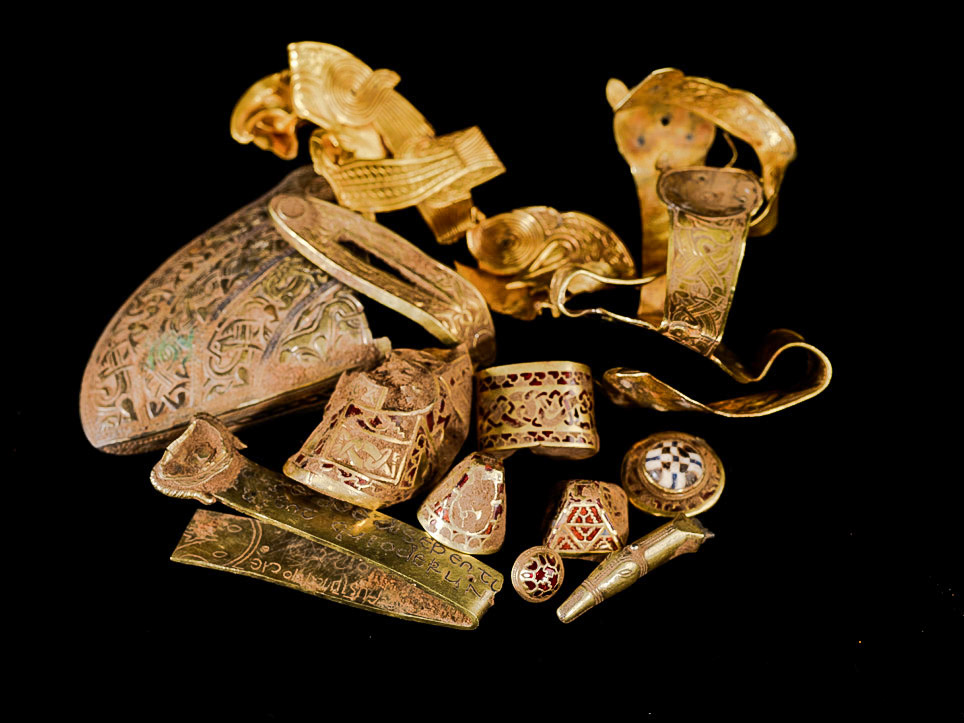 |
| Items from the Staffordshire Hoard. Courtesy Wikimedia Commons. |
Friday, September 16, 2011
Swordplay by warriors at Downham
"Visitors to St Edmond’s Church, Downham, enjoyed the demonstrations put on by the Anglo Saxon re-enactors, who played a wise woman, warriors and a Benedictine monk." Full story at Lynn News.
Sunday, September 11, 2011
Life in a Saxon hall
The re-enactment society Regia Anglorum is reconstructing an early medieval Saxon hall in Kent using materials and construction methods of the time. Read the full story at the Guardian.
Early Anglo-Saxon personal equipment and structural ironwork from Saltwood Tunnel, Kent
Originally posted at Medievalists.net.
"The personal equipment from the early Anglo-Saxon cemeteries at Saltwood includes horse harness, gaming pieces, a leather pouch or shoe, keys, chatelaines and rings, chain, tweezers, lozenges, a quartz crystal ball, knives and their sheaths and a number of miscellaneous iron implements." Read the complete article here.
"The personal equipment from the early Anglo-Saxon cemeteries at Saltwood includes horse harness, gaming pieces, a leather pouch or shoe, keys, chatelaines and rings, chain, tweezers, lozenges, a quartz crystal ball, knives and their sheaths and a number of miscellaneous iron implements." Read the complete article here.
Subscribe to:
Posts (Atom)