Showing posts with label Mercia. Show all posts

Saturday, February 25, 2012

Penda the Pagan: Royal sacrifice and a Mercian king

Courtesy Medievalists.net:
"Penda, a seventh-century king of Mercia, was a noted regicide. Indeed, his other achievements – his military campaigns and a crafty and unlikely alliance with the British king Cadwallon were instrumental in carving out Mercia as an independent kingdom and establishing it as a power to be reckoned with – were almost completely overshadowed by his reputation as a slayer of kings. As Penda was a pagan, and his alleged victims all Christian, it comes as no surprise to find that medieval chroniclers, mostly monks or Christian nobles, viewed his reign and deeds with horror and denigrated him at every opportunity. The reputation of his ally Cadwallon, himself a Christian, suffered by association: in his Historia Ecclesiastica Gentis Anglorum, written in the early eighth century, Bede of Jarrow describes him as ‘a barbarian more savage than any pagan’ with ‘no respect for the newly established religion of Christ’ [1]. Bede’s invective was not tempered by the fact that Cadwallon was a Celt."
The full article by Alby Stone originally published in Mercian Mysteries, may be read in full on At the Edge.

Friday, January 6, 2012

Christmas Day in Anglo-Saxon Tamworth


"At Offa's Christmas feast venison or pork would be roasted on a spit over the open fire in the palace, with someone appointed to baste the beast.

The smell of the roast would galvanise the appetites of all and sundry and great chunks of meat would be sliced or ripped off the animal with gusto.

Hygiene was very low on the agenda and, in the preparation of the various meats, the intestines and other unusable waste from the animals would be thrown on the floor for the dogs to consume.

What they left behind would attract the mice, rats and other vermin.

A few lucky peasants who happened to be servants at the Christmas banquet may have been able to help themselves to the carcass leftovers, probably wrapping it in hessian and taking it home, their equivalent of the 'doggy bag'."

The full description of this feast at the Mercian king's palace may be read at the Tamworth Herald.

Wednesday, November 23, 2011

Saxon burial ground under Warwickshire couple's home

"...archaeologists identified the remains of at least four bodies which included two adult females, a young male and a juvenile aged between 10 and 12. ... Radiocarbon dates from two of the skeletons show that they died around 650-820 AD in what is known as the middle Saxon period." Read the full story at the BBC.

Wednesday, September 21, 2011

Wikipedia entry for the day: Mercia

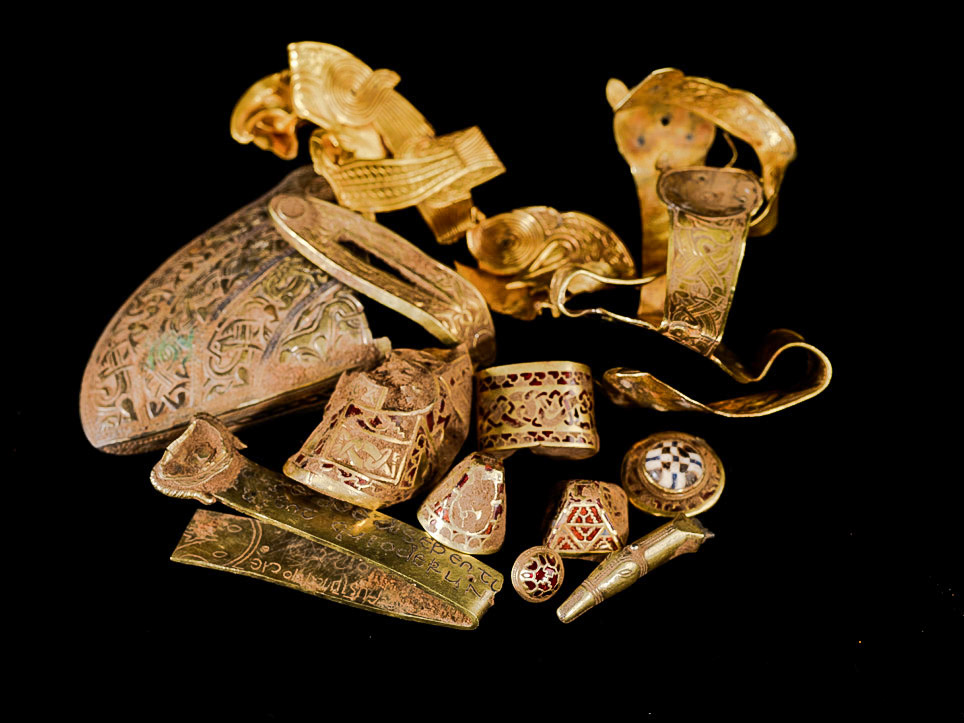
Items from the Staffordshire Hoard. Courtesy Wikimedia Commons.
"Mercia was one of the kingdoms of the Anglo-Saxon Heptarchy. It was centred on the valley of the River Trent and its tributaries in the region now known as the English Midlands. The name is a Latinisation of the Old English Mierce or Myrce, meaning 'border people'." Read the full article at Wikipedia.

Why don’t we rebuild King Offa’s palace?

Offa in a 13th century manuscript.
Courtesy Wikimedia Commons.
"It was one of the most impressive buildings of its time, described in ancient documents as ‘the admiration and wonder of the age’. Erected by King Offa, the mightiest of the early Mercian rulers, it remained a royal palace for over 100 years." Read the full story at Herald History." Read the full story at Herald History.