"According to a new journal article by Shane McLeod in Early Medieval Europe, the concept of the male Norse invaders migrating across England in the 9th and 10th centuries CE is potentially biased. He argues that based on burial evidence, females were equal in number if not outnumbering the males, leading to a new interpretation of the Norse migration. Textual evidence of the Norse invasion into Britain notes the presence of women and children in some of the invading groups, but primarily they focus on the high number of male warriors. McLeod argues that there were more women than previously thought based skeletal analysis, and this requires a reinterpretation of the Norse invasion."
Read the full article at Bones Don't Lie.
Friday, February 10, 2012
Viking Ethnicities: A Historiographic Overview
Courtesy of Medievalists.net:
"The ‘Viking Age’ is well established in popular perception as a period of dramatic change in European history. The range of viking activities from North America to the Middle East has excited the interest of many commentators. Vikings are variously regarded as blood thirsty barbarians or civilised entrepreneurs; founders of nations or anarchic enemies. But how cohesive was the identity of the ‘Vikings’ and how did they see themselves? In recent years the answer to this question has been evaluated from a range of perspectives. Established paradigms (often situated within a nationalist framework of thought) have come under greater scrutiny and new ideas have entered the debate. This paper will review some trends in the historiography of viking ethnicities and cultural identities in the period 800–1000 AD. This overview also highlights the value of comparative analysis of human migrations to the field of Viking Studies." The full article by Clare Downham of the University of Liverpool, originally published in History Compass, Volume 10, Issue 1, may be read in PDF format at the Wiley Online Library.
Northern Wisdom - The Havamal, Tao of the Vikings
YouTube trailer for Eoghan Odinsson's new book, due out 27 February. For more information, visit his site.
What did Old Norse sound like?
Readings by Jackson Crawford of UCLA from Völuspá, Hávamál, and Grímnismál. For further inforamtion, visit his blog.
Thursday, February 9, 2012
Remembering Eyvind Kinnrifi
On this day, 9 February, many followers of the Northern Traditions remember Eyvind Kinnrifi, a Norwegian noble landowner who was tortured to death on orders of Olaf I for refusing to abandon his ancestral faith and convert to Christianity. Some accounts say he was drowned, but most say he was instead tied to a table and had a brazier of hot coals placed upon his belly, which eventually burst open from the intense heat.
Wednesday, February 8, 2012
Lagarfljótsormur
This story has begun to circulate recently:
"A video was recorded this weekend of what may or may not be the legendary Lagarfljóts Worm — Iceland’s answer to the Loch Ness Monster.
The video was taken of what looks like a giant, icy swimming snake in the Jökulsá í Fljótsdal river, which runs in to Lagarfljót. The unexplained creature, or phenomenon, appears to be swimming upstream, against the current." Read more, with link to the video footage, at Ice News.
Monday, February 6, 2012
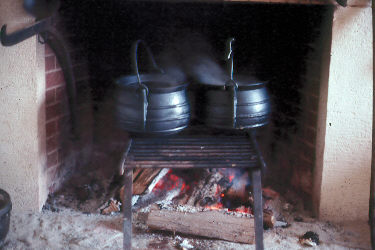
Hearth Cooking: An Ancient Cooking Technique Revisited
![]() |
| National Park Service |
"Hearth cooking is an ancient and wonderful craft. It is the craft that stands at the center of European cuisine. With few exceptions, all recipes that originated in Europe were first created on an open hearth and only adapted comparatively recently to the modern kitchen."
Read more at Mother Earth News.
Labels:
Berchta,
Cooking,
Frau Holle,
Frau Perchta,
Frigga,
hearth,
hearth wights,
Holda
Subscribe to:
Posts (Atom)